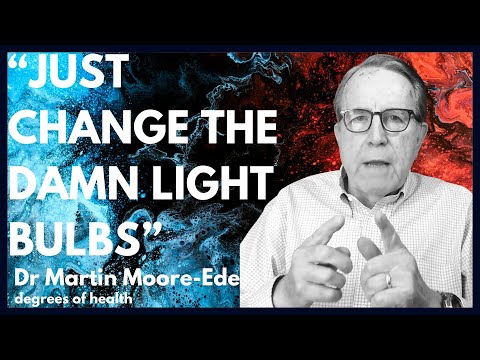
Welcome to this presentation on the profound connection between light and health. For most of human history, our lives revolved around the rising and setting sun. But in our modern world, artificial light dominates — and it’s changing how our bodies function. As Dr. Martin Moore-Ede says, “Light is as vital to our health as the air we breathe.” Today, we’ll explore how light affects our biological clocks, our hormones, and even our risk of disease — and what we can do to realign with nature’s rhythm.
|
|
Dr Martin Moore-Ede | Why Your Health Hinges on the Light You See |
Light is not just what allows us to see — it’s a powerful biological signal. It tells every cell in our body what time it is. The quality and timing of the light we’re exposed to affect our mood, energy, sleep, and long-term health. Yet, modern life traps us indoors, under artificial lighting that confuses our body’s natural timing systems. Understanding light’s true role in our biology helps us take control of one of the simplest yet most powerful factors for good health.
For most of human evolution, evenings were lit by firelight — warm, red, and comforting. But modern LEDs emit blue-rich light that mimics daytime sky. This blue light keeps us alert and awake when we should be winding down. The issue is that energy efficiency regulations favor these blue-heavy LEDs, ignoring how they affect human health. What’s efficient for electricity isn’t necessarily efficient for our biology.
Our lighting standards focus on “lumens per watt,” measuring brightness but not wellness. True efficiency should consider how light interacts with our bodies — not just our eyes. By removing red and infrared components, modern lighting saves power but costs us health. This is what Dr. Moore-Ede calls “false energy efficiency.” We’re trading biological harmony for electrical savings.
Inside your brain lies the master clock — the suprachiasmatic nucleus, or SCN. It keeps your body running on a 24-hour rhythm. Special light sensors in your eyes called ipRGC cells detect sky-blue light around 480 nanometers. This signal keeps your body in sync with day and night. But when you see this light at night, it sends the wrong message — telling your brain it’s still daytime.
Melatonin is your body’s natural sleep and repair hormone. Blue light during the day helps suppress melatonin when you need to be alert. But at night, that same light delays its release, preventing deep sleep and repair. Imagine trying to heal or rest while your body still thinks it’s noon — that’s what evening blue light does to us.
When our biological rhythms go out of sync, disease risk rises. Studies show strong links between circadian disruption and cancer, obesity, diabetes, heart disease, and depression. Even small disruptions — like staying up late under bright screens — accumulate over time. The good news is, by restoring light balance, we can reverse much of this harm.
Sunlight contains every color of the rainbow — and more. Indoor lighting, however, strips away ultraviolet and infrared light. UV light helps create Vitamin D and keeps our eyes healthy, while infrared light boosts cell energy and tissue repair. Research shows that people who spend time outdoors, even with a slight increase in skin cancer risk, actually live longer. Nature’s light is healing in ways we’re just beginning to understand.
Infrared light — invisible to the naked eye — penetrates deep into the body, energizing our cells. It improves mitochondrial function, promotes tissue recovery, and increases relaxation by enhancing heart rate variability. When added to indoor lighting, infrared creates a more natural and calming environment that supports both physical and emotional health.
Morning sunlight is the single most important light exposure of the day. It sets your body’s clock, boosting mood, focus, and energy. Psychiatric patients exposed to morning sunlight have shown faster recovery times. Stepping outside within 30 minutes of waking can reset your internal rhythm for the day — no supplements or gadgets needed.
You don’t need complex technology to fix your light health. Get natural daylight during the day. Avoid blue-rich lights in the evening. Sleep in complete darkness — no nightlights or glowing gadgets. If you need to move around at night, use red light. And for screen use, wear orange or amber blue-blocking glasses. These small actions bring huge benefits to sleep, focus, and mood.
We can make a difference by supporting healthy lighting policies. Many current energy rules ban bulbs that are biologically friendly. Advocating for full-spectrum, human-centric lighting is essential for public health. Join movements that challenge outdated efficiency standards. Better light isn’t just a luxury — it’s a necessity for life.
Our ancestors lived in harmony with sunlight and darkness. The further we’ve drifted from that natural rhythm, the more health issues have appeared. Light is not decoration; it’s a biological command. By respecting nature’s cycle, we can restore balance to our bodies, improve longevity, and rediscover vitality.
Every sunrise is a gift — a chance to start fresh. Step outside, take in the light, and let it reset your system. In the evening, dim the lights and give your body permission to rest. Your lighting choices shape your health and longevity. The solution is simple, free, and waiting outside your window: natural light.
This presentation draws on the groundbreaking work of Dr. Martin Moore-Ede and leading studies from Harvard, the WHO, and Swedish health researchers. To explore more, visit healthylightrevolution.org and begin your own journey toward light-based wellness.