📉 Cross Entropy Visualizer
🎯 True Labels (One-hot)
🔮 Predicted Probabilities
📘 What Is Cross Entropy?
Cross-entropy is a key loss function used during training of classification models. It compares the predicted probability distribution to the true label (usually one-hot encoded).
Cross-entropy is a loss function that tells us how close our predicted probability distribution is to the actual distribution (true labels).
Used in classification problems, especially with softmax outputs in neural networks.
🧠 Formula:
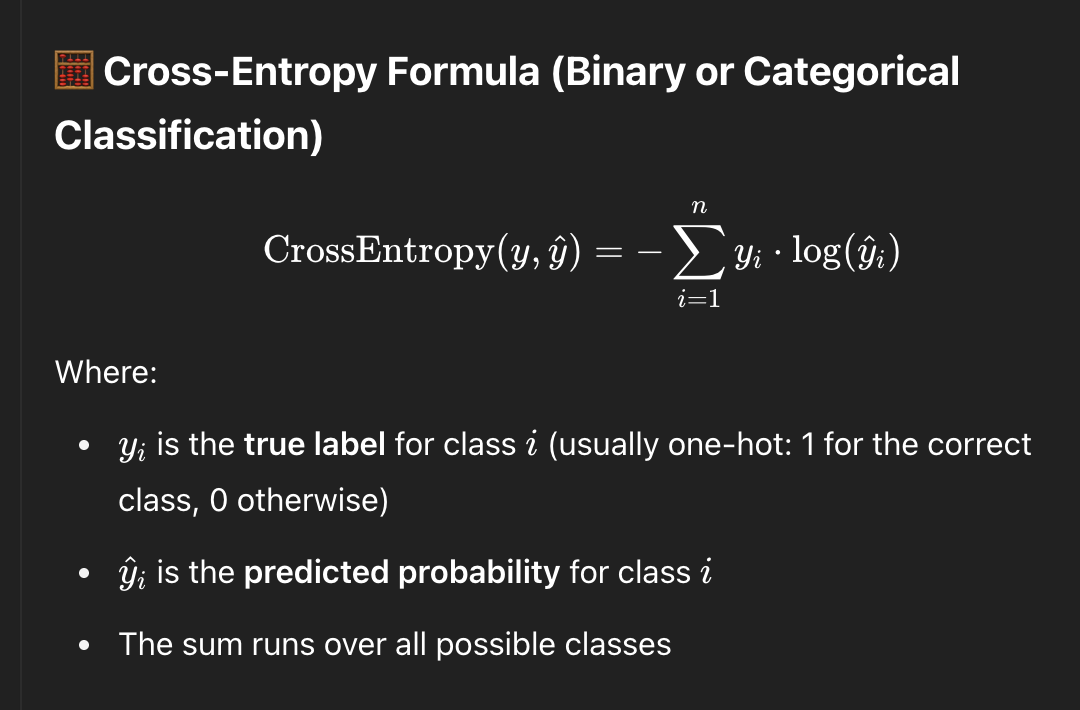
In words: For each class, we multiply the true label (1 or 0) by the log of the predicted probability, sum them up, and negate the result.
🔄 Relationship Between Softmax & Cross-Entropy
- Softmax converts logits (raw model outputs) into probabilities.
- Cross-entropy then compares those probabilities to the true labels.
- Together, softmax + cross-entropy measure how well the model is predicting the correct class.
- Frameworks like PyTorch combine them internally in functions like
CrossEntropyLoss(which applies softmax automatically).
⚙️ When Is Cross-Entropy Used?
- During training: Softmax + Cross-Entropy are applied at the final output layer.
- During inference: Only softmax is used to get class probabilities. No loss is calculated — we already have a trained model.
🧱 Common Architecture Pattern
Input → [Hidden Layers] → Final Linear Layer → Softmax → Cross-Entropy Loss
(Softmax + Cross-Entropy used only during training)
📎 Special Cases
- Auxiliary Losses: Some networks like Inception or DeepLab apply additional cross-entropy losses at intermediate layers to help with training.
- Multi-Task Learning: Multiple outputs may have different loss functions applied.
Summary:
✅ During training, use Softmax + Cross-Entropy at the output layer
✅ During inference, use Softmax only — no loss is calculated
✅ PyTorch and TensorFlow often handle softmax + cross-entropy internally for numerical stability
✅ During training, use Softmax + Cross-Entropy at the output layer
✅ During inference, use Softmax only — no loss is calculated
✅ PyTorch and TensorFlow often handle softmax + cross-entropy internally for numerical stability